

Specialty – Digital Twin for Health (DTH)
The Digital Twin for Health (DTH) programme focuses on healthcare technologies from a systems engineering perspective.
Pedagogical context
The DTH programme builds on UTC's long-standing expertise in biomechanics and biomedical engineering. It aims to move beyond traditional disciplinary boundaries by bringing together various fields (engineering sciences, life sciences and humanities) through a multidisciplinary approach to education.
The programme aims to equip students with advanced skills in biomechanical systems modelling, biomedical and healthcare data analysis, and the development of decision-support tools.
The main areas of study include:
- Modelling of living systems;
- Digital twins;
- Processing of heterogeneous and multimodal data, and knowledge extraction;
- Modelling and management of complex physical systems, multiscale and multiphysics analyses, and inverse problems;
- Artificial intelligence (AI) methods;
- Biomechanics and bioengineering.
Organisation
The Digital Twin for Health (DTH) programme is structured over four semesters: three semesters of theoretical and practical coursework (M1S1, M1S2 and M2S3), followed by one semester (M2S4) devoted exclusively to a long-term internship (22 to 24 weeks). A short-term internship (one month) at the end of the first semester is also compulsory.
First and Second Semesters of M1
The programme comprises:
- Specialised scientific and technical courses covering biomechanics, modelling, AI methods, experimental data analysis and associated protocols;
- Courses designed to strengthen disciplinary knowledge, shared with UTC's engineering programmes (Biomedical Engineering and Biomechanics and Biomaterials specialisations);
- Courses in communication skills (particularly aimed at achieving the required level of proficiency in a foreign language), business and management (management, project management, etc.), and research methodology and literature review techniques;
- Finally, all M1 students are required to complete a compulsory one-month internship between semesters, providing an initial opportunity to gain experience in a research laboratory.
First Semester of M2
The first semester of M2 consists of:
- An initial teaching period of three months (equivalent to half a semester), focusing on the fundamentals of hybrid modelling of biomechanical and physiological systems, as well as advanced analysis of heterogeneous data for the development of digital twins;
- A second three-month teaching period, during which students deepen their knowledge through specialised courses. The programme reflects the main research areas of the BMBI laboratory.
The programme draws on existing courses from the Complex Systems Engineering (ISC) and IDC Master's programmes, as well as engineering course units, for the M1 curriculum.
Contact et documentation
Concilier ses deux passions : l’ingénierie et l’événementiel

Une levée de fonds pour soutenir le sport de haut niveau à l’UTC
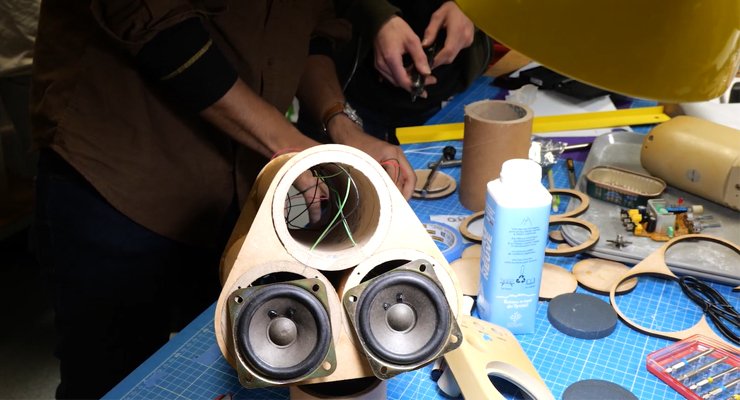
L’optimisation et l’upcycling des produits, credo des API